

Painting Pretty Ponds
by Jennifer Rae Ochs
These days, it seems that almost every conversation eventually turns to the same place.
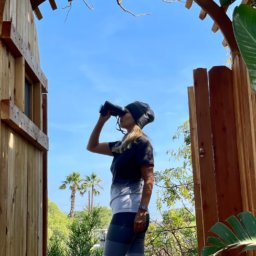
Not immediately. It usually begins casually enough, someone stepping into my mobile gallery booth, making a light comment about color or texture. With time, the conversation deepens. A recent travel story. The excitement of a new home in a warm winter place. A small joy worth celebrating.
And then, inevitably, the shift comes.
The pace of change.
The uncertainty people feel.
The sense that the world has become louder, faster, and more fractured.
I’ve come to expect it.
The exhibit booth often becomes a small refuge for conversation, a place where strangers speak honestly about life, work, family, the news cycle, and the emotional weight many are carrying. And yet, beneath it all, there is still something steady and consistent: a deep desire to share a moment.
Not long ago, during one of my own moments of frustration with the state of the world, someone in my life offered me a perspective that stopped me mid-rant.
Bruce is a neighbor turned dearest friend, the kind of person who quietly changes lives. A historian, musician, veteran, retired teacher, and over forty years sober, he has lived a full life, not perfectly, but with depth, curiosity, and faith. An avid reader, he dedicates part of his retirement to sponsoring those in need and teaching people leaving prison how to read.
I often say, half-joking and entirely serious, that I’ve been enrolled in his unofficial doctorate program for years.
In our conversations about the world—its chaos, its beauty, its contradictions—Bruce has a way of offering perspective that cuts through everything else. Sometimes he references Balzac or Shakespeare. Sometimes it’s The History of India or The History of China by John Keay. Recently, he has been revisiting the Gilded Age, WWI, and other defining moments in history. Whatever the moment, he has a remarkable ability to reframe things with clarity, and willing to share his knowledge with me.
So there I was, talking with Bruce, feeling impatient and fed up with the world, sharing recent phone calls I had received from people searching for optimism, for something steady to hold onto. And underneath it all was the question: how do we, as humans, keep moving forward with grit and hope while constantly absorbing the bombardment?
That’s when he interrupted me.
“Jennifer,” he said calmly, “what do you think Claude Monet was doing during the world strife of his lifetime?”
I paused.
“I don’t know… he was painting pretty ponds?”
The simplicity of the answer was the point.
Claude Monet lived through the Franco-Prussian War, endured financial hardship, lost loved ones, and later faced the slow deterioration of his eyesight due to cataracts. As his vision faded, he did not stop, he expanded, creating monumental works that now fill entire rooms with color and light.
And yet today, we do not remember him for the chaos of his era, political speeches, or collapsing institutions.
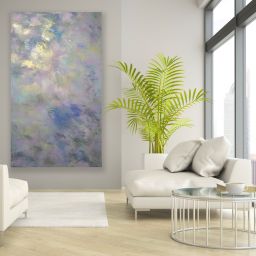
We remember water lilies.
Soft light on water.
Reflections shifting across a pond.
For decades, Monet studied light and atmosphere in his garden at Giverny, painting the same pond repeatedly as it changed with time, weather, and season.
In a lifetime surrounded by upheaval, he focused on something else entirely.
A pond.
A garden.
A shifting moment of light.
I’ve started sharing this story with people I meet along the way, friends, artists, collectors, festival-goers. Almost every time, something shifts. The tone changes.
The point is simple: each of us, in our own way, has the ability—and responsibility—to create beauty and meaning, and to stay connected to our work, our purpose, and our part in making the world a little more steady, thoughtful, and good.
Because the truth is, none of us are strangers to the weight of the world.
And yet we still get to choose what we surround ourselves with, the art on our walls, the relationships we nurture, the conversations that bring us back to ourselves, and the beauty we allow ourselves to notice.
Inside the constant exchange of ideas that unfolds in that modest art booth, I am reminded how powerful simple human conversation can be. Thoughtful dialogue lifts us, reminding us that beneath the headlines and pace of modern life, people are searching for meaning, connection, and moments of peace.
That was the quiet wisdom my friend offered me that day.
We cannot ignore the world, near or far. But within it, we can choose love. We can choose beauty. We can choose reflection, the things that steady us.
And when we do, something remarkable happens.
The conversation itself begins to lift us, one shared moment of light at a time.